Downunder
A Boy and His DogDownunder is the enclosed civilization created after the wars to shelter selected communities from the ruined surface. Its decisive significance lies in the contradiction between survival and living: it protects people from radiation, mutation, and social violence, but preserves them by eliminating ecological contact, dissent, unpredictability, and freedom. Through its architecture, customs, reproductive policies, and restricted culture, Downunder becomes less a refuge than a controlled experiment in whether humanity can survive by turning life into administration.
Origins and Social Design
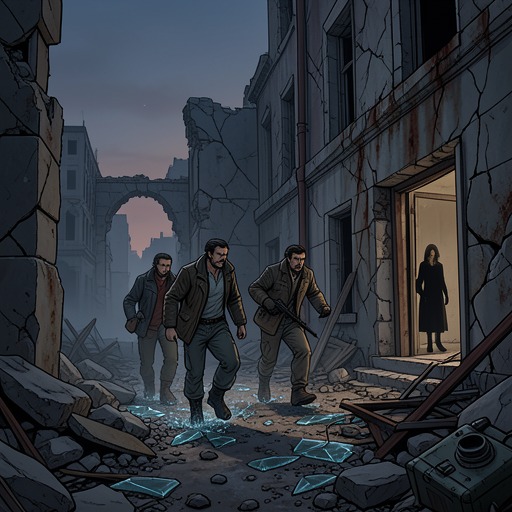
Downunders are subterranean settlements established in the few hundred sites remaining across the United States and Canada. They were sunk over wells, mines, and other deep holes; some western settlements occupied natural cave systems. Their great depth—roughly two to five miles—made them resemble enormous caissons standing on end. This engineering responds directly to the devastated surface, where radiation still flickers from the hills and where craters, screamers, and other dangers make ordinary settlement impossible.
The people who founded these communities are described as intensely conservative middle-class groups: Southern Baptists, fundamentalists, law-and-order traditionalists, and others who rejected the uncertainty and experimentation associated with modernity. They used the last surviving scientists to devise the means of construction and survival, then expelled those scientists. The founders wanted neither progress nor dissent. Their model of safety was a return to an imagined social order from before the First War, when they believed quiet domestic life could be preserved by keeping disruptive change outside the community.
Downunder society therefore rests on deliberate historical regression. It does not merely hide from the postwar world; it selects an earlier ideal and seals that ideal inside machinery. The result is a civilization organized around continuity, politeness, conformity, and reproduction rather than discovery. Its apparent stability is purchased by making the outside world, scientific progress, and individual difference into threats.
Physical Environment and the Loss of Nature
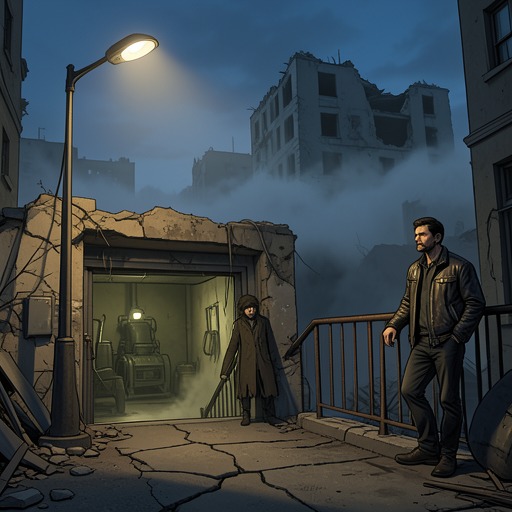
The scale of a Downunder becomes visible when Vic enters one. After descending through the access shaft past faint wall markings such as “10 LEV,” “ANTIPOLL 55,” “BREEDER-CON,” and “PUMP SE 6,” he reaches a lower level marked “TOPEKA CITY LIMITS POP. 22,860.” An iris opens onto a town twenty miles across, enclosed within a vast metal tube whose ceiling rises an eighth of a mile overhead. The settlement contains neat houses, curved streets, trimmed lawns, a business district, and the other visual signs of an idealized Topeka.
The resemblance to a surface town is immediately undermined by what is missing. Downunder has no sun, birds, clouds, rain, snow, cold, wind, ants, dirt, mountains, oceans, open grain fields, stars, moon, forests, or animals running wild. Its lawns and streets reproduce the appearance of nature while excluding nature’s forces and inconveniences. The town is a picture of a world rather than a world in its own right, a carefully maintained image placed at the bottom of a metal container.
The most important absence is freedom. The enclosed settlement protects its inhabitants from the radioactive and biologically damaged surface, but the same enclosure turns protection into captivity. The overhead earth has a physical weight, and the metal walls seem to close in around Vic. In this sense, the architecture externalizes the society’s governing principle: danger has been held outside, but choice has been held outside with it. Downunder’s safety is a form of slow violence because life continues inside an environment from which living systems have been systematically removed.
Order, Food, and Reproductive Crisis
One Downunder settlement presents itself as a quiet, orderly community of respectful citizens. Its spokesman claims that the residents have lived in Topeka for nearly thirty years, with no crime, respect for elders, and general prosperity. This self-description reveals the settlement’s civic ideal: social behavior is valuable insofar as it is predictable, courteous, and non-disruptive. The community defines goodness through the absence of conflict, not through the presence of freedom or meaningful alternatives.
Its material abundance is equally artificial. The food served there consists of artificial peas, fake meat, make-believe chicken, ersatz corn, and bogus bread. To Vic, these substitutes taste like chalk and dust. The food demonstrates how thoroughly Downunder has replaced ecological dependence with technical manufacture. It has preserved the names and forms of ordinary nourishment while losing the sensory and material reality those names once carried.
The settlement’s reproductive system exposes a deeper failure. Some residents can no longer have children, and the women who can give birth produce mostly girls. Downunder therefore needs men of a particular kind, and Vic is told that he is being used as an experiment. The community’s calm surface conceals demographic panic: infertility and gender imbalance threaten the continuity that the entire underground project was designed to guarantee. Its supposed mastery over nature has not abolished biological limits; it has made those limits politically urgent.
This crisis also clarifies the relationship between the surface and the underground. On the surface, the Third War killed most of the girls, while many births produced organisms that were neither conventionally male nor female and had to be killed immediately. Downunder preserves more conventional domestic life, but it cannot escape the consequences of the same historical catastrophe. The underground’s reproductive policy is thus not evidence of complete separation from the ruined world. It is the delayed return of the surface’s violence in bureaucratic form.
Culture, Movies, and the Boundary of the Outside
Downunder culture is marked by strict regulation as well as by nostalgia. Residents come from communities where social respectability and restraint dominate, and their entertainment is imagined as clean, old-fashioned, and sexually conservative. Vic knows that Downunders make films resembling the productions of the 1930s and 1940s, in which even married couples sleep in twin beds. Occasionally, a woman from one of these strict communities rises to the surface to see what a more explicit film is like, a rare breach of the boundary between sealed order and dangerous curiosity.
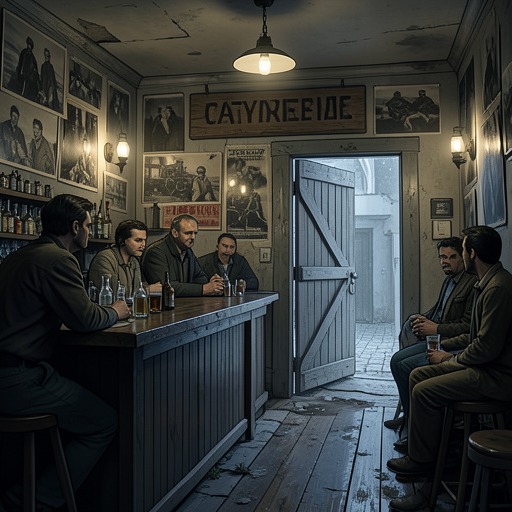
That boundary is especially visible at the Metropole Theater, a surface sanctuary controlled by Our Gang. The roverpak has survived not by ordinary foraging but by taking over the theater’s territory and keeping films running. Its service is accepted because even isolated survivors such as Vic and Blood need access to movies. The theater preserves fragments of prewar culture amid radiation and violence, while Downunder preserves a sanitized social image of prewar respectability.
The contrast between the theater’s films and Downunder’s presumed standards makes moving images a contested form of memory. The Metropole shows an old revenge film, a brutally violent Third War production, and an explicit late-1970s film. The first has deteriorated so badly that it repeatedly slips its sprockets, yet its story of a betrayed solo seeking revenge remains compelling. The second turns wartime slaughter into spectacle, including skirmisher greyhounds equipped with napalm throwers. The third offers the sexual material that draws a rare Downunder visitor upward. Together, these films make the surface a forbidden archive of violence, desire, and historical excess—the very experiences Downunder attempts to exclude.
The occasional journey upward reverses the usual understanding of civilization. Downunder residents possess shelter, food production, and formal order, but some are curious about the forbidden surface precisely because it contains what their society has erased. The surface is dangerous and degraded, yet its films and encounters still offer forms of intensity unavailable inside the sealed town. Downunder’s prohibition of disorder therefore creates the desire that sends people beyond its walls.
Dystopian Significance
Downunder is not presented as a simple opposite to the surface. The surface is violent, radioactive, sexually predatory, and ecologically devastated; Downunder is clean, polite, technically sustained, and socially organized. Yet the two worlds reproduce different versions of the same historical damage. On the surface, catastrophe appears as immediate danger: radiation, craters, mutated births, armed groups, and scarce women. Underground, catastrophe becomes institutional: artificial food, compulsory social scripts, reproductive experimentation, cultural censorship, and the psychological pressure of permanent enclosure.
Its central irony is that the community has achieved the conditions of survival by rejecting the conditions of freedom. The town’s neat houses and lawns imitate a vanished landscape, but the missing sun, soil, weather, animals, and open horizons reveal that the imitation has displaced the original. Residents are safe because they are cut off from the world, and they are trapped because they are cut off from the world. The more completely Downunder controls its environment, the less fully its inhabitants participate in life outside the system’s definitions.
As a dystopian concept, Downunder extends postwar environmental destruction into a long-term social form. The radioactive surface is not merely a past disaster; it remains an active background that shapes population, settlement, food, sexuality, and political authority. Downunder’s orderly civilization is therefore a response to slow ecological ruin, but it also normalizes that ruin by designing an existence in which nature no longer needs to be repaired. Its ultimate promise is survival without freedom, and its underlying warning is that a society may preserve the image of humanity while eliminating the world that makes human life open, unpredictable, and alive.